
Our Work > Summer Teacher Lab 2026: Summary Report
Summer Teacher Lab 2026: Summary Report
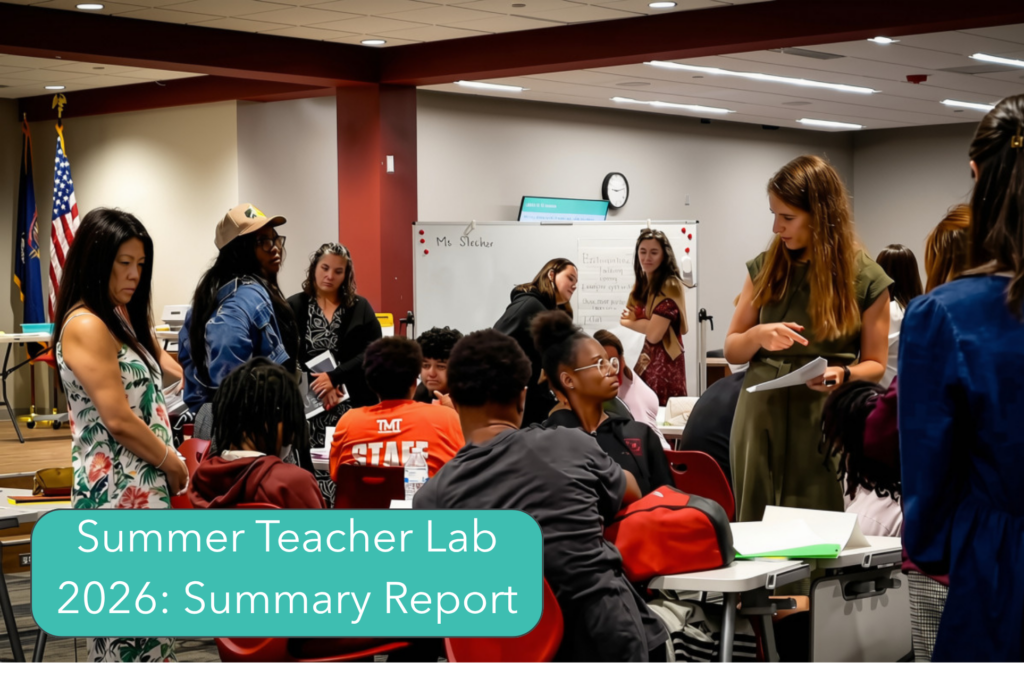
In June 2026, Math Medic Foundation hosted its inaugural Summer Teacher Lab, an innovative professional learning experience designed to strengthen equitable mathematics instruction by bringing teachers and students together in the same learning environment.
Over four days, 20 secondary mathematics teachers from across the United States and 20 high school students gathered together in the same classroom. Each morning, students participated in 3½ hours of mathematics instruction while teachers observed. Rather than participating in the instruction, teachers focused entirely on understanding student thinking, noticing instructional decisions, and documenting evidence of student engagement and mathematical reasoning. Each afternoon, teachers spent three hours unpacking what they had observed, reflecting on instructional moves, discussing research, and planning how those ideas could transfer to their own classrooms.
Participants and Setup
Teachers were selected from more than 240 applicants nationwide, while students were recruited from East Kentwood High School’s summer school program. Every participating student came from a low-income household, and most entered the week with below-proficient mathematics assessment scores. Like many students attending summer school, they began the week understandably reluctant, skeptical about a week full of math, and exhibiting the social behaviors one would expect from a newly formed group.
The model teacher for the week was Sarah Stecher, Chief Content Creator at Math Medic, whose work has supported thousands of mathematics teachers through curriculum design, professional development, and national conference presentations. Throughout the week, Sarah modeled instructional practices while making her decision-making visible to the observing teachers.
The professional learning centered on helping teachers move from Vision 1 mathematics instruction, where success is measured primarily by correct answers and following procedures, to Vision 2 mathematics instruction, where success is about making sense of mathematics and justifying reasoning together (Seda, 2025). Teachers spent the week observing and exploring four key commitments:
- Giving students rich mathematical tasks worth thinking about.
- Creating classroom environments where thinking is visible and valued.
- Believing every student is capable of making sense of mathematics.
- Connecting mathematics to students’ culture, experiences, and identities.
Measuring Our Impact
Students and teachers completed surveys before and after Summer Teacher Lab using a five-point Likert scale. The surveys measured students’ mathematical identity and classroom experiences, as well as teachers’ beliefs about equitable mathematics instruction.
The results were nothing short of remarkable.
Every single Likert-scale item moved in the desired direction for both students and teachers. Many of the changes were statistically significant using a matched-pairs analysis (p < 0.05), providing strong evidence that meaningful shifts occurred in just four days.
Students Experienced Mathematics Differently


The most encouraging outcome of Summer Teacher Lab was not simply that students enjoyed the week, it was that they began to see themselves differently as mathematical thinkers.
Students showed statistically significant increases in their agreement that:
- Math is fun.
- Math is something they can learn.
- They get to share their ideas in math.
- They get to make choices while learning.
- They can persevere through challenging problems.
- Mathematical reasoning helps them make better decisions in life.
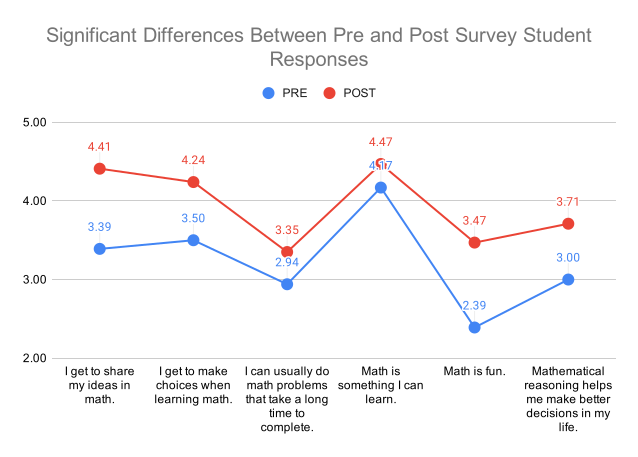
These findings point toward meaningful growth in students’ mathematical identity. Rather than viewing mathematics as something to get through, students increasingly described it as something they could actively participate in and succeed at.
One of the clearest examples came from students’ written responses to the question “What do you do in your math classes?”
Before: “I do my work most of the time.”
After: “I learn to tackle challenging problems in math class and I learn how to solve different problems in different ways.”
Another student described a similar shift.
Before: “Take notes, apply notes to practice problems.”
After: “I work with groups to solve problems and find answers.”
These comments mirror exactly the type of classroom experience Summer Teacher Lab was designed to create: one where students explore multiple strategies with one another and see themselves as capable contributors to mathematics.
Perhaps the most striking result was the increase in students’ agreement that “Math is fun,” which increased by more than one full point on a five-point scale (p < 0.0001). Equally encouraging was the increase in students’ belief that “Math is something I can learn” (p < 0.001), a key indicator of a developing mathematical identity.
Teachers Saw Students Differently
Teachers also demonstrated meaningful shifts in beliefs and confidence that align closely with ambitious, equitable teaching practices.
By the end of the week, teachers were significantly more likely to believe that:
- Comparing different strategies for solving a problem is more valuable than showing one method that all students can follow.
- Most problems can be solved in more than one way.
- I feel comfortable facilitating a discussion that compares and connects students’ different solution strategies.
- I feel prepared to make instructional decisions in-the-moment based on students’ mathematical thinking.
Just as importantly, teachers showed decreased agreement with beliefs that often limit student opportunities, including:
- There is often not time for rich tasks that focus on conceptual understanding.
- Students need to master the basics before they can be given deeper reasoning tasks.
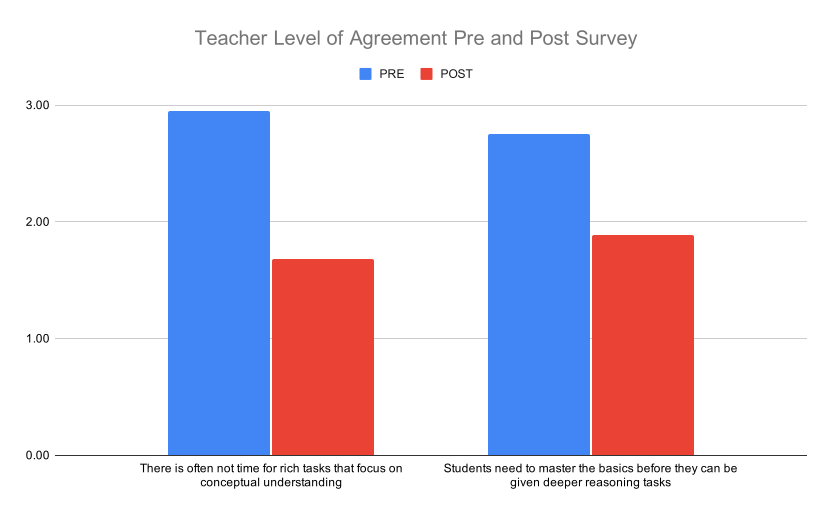
These changes suggest that observing students engage successfully with rich mathematical tasks helped teachers rethink long-held assumptions about what students are capable of doing. Rather than lowering expectations, teachers left with greater confidence that all students can engage in meaningful mathematical reasoning when given the opportunity.
One teacher reflected:
“This was a real-life classroom with real students. The students had behavior issues that we all struggle with. They were not ‘model’ students. I loved seeing their growth in real time throughout the week.”
Another wrote:
“Watching the growth in student thinking, confidence, and trust was one of the highlights of the week.”
Teachers also described specific instructional changes they planned to make.
“My biggest takeaway is to have a poker face when it comes to student answers and treat all answers equally instead of letting my body language give away the answer.”
Another participant captured the shift in classroom culture:
“I loved experiencing the tone difference of staying focused on the group norms as opposed to typical classroom management.”
These reflections reinforce what the survey data suggest: teachers were moving beyond simply learning new instructional strategies to developing new ways of seeing students.
Looking Ahead
To better understand the long-term impact of Summer Teacher Lab, both teachers and students will complete the same survey again midway through the 2026–2027 school year. This follow-up will help us determine whether the positive shifts observed during the week were sustained once participants returned to their regular classrooms and schools.
These data will guide future improvements to Summer Teacher Lab while helping us better understand how immersive professional learning experiences can create lasting change for both teachers and students.
Just the Beginning
Launching the first Summer Teacher Lab was an ambitious undertaking. It required months of planning, outstanding partners, dedicated teachers, courageous students, and a shared belief that mathematics classrooms can become places where every student feels capable of thinking deeply.
In just four days, students reported stronger mathematical identity, greater enjoyment of mathematics, and increased confidence tackling challenging problems. Teachers strengthened beliefs that support ambitious, equitable instruction while leaving with renewed confidence in what students can accomplish.
Four days is not enough to transform mathematics education. But four days was enough to demonstrate what becomes possible when students are trusted to think and given the chance to reach the high expectations of a teacher who believes in them.

Pete Grostic, Ph.D
Executive Director
Please join Math Medic Foundation in our mission to improve math outcomes for all. You can contact us to get involved or donate here.