Our Work > Summer Teacher Lab Deep Dive: Cultivating Norms
Summer Teacher Lab Deep Dive: Cultivating Norms
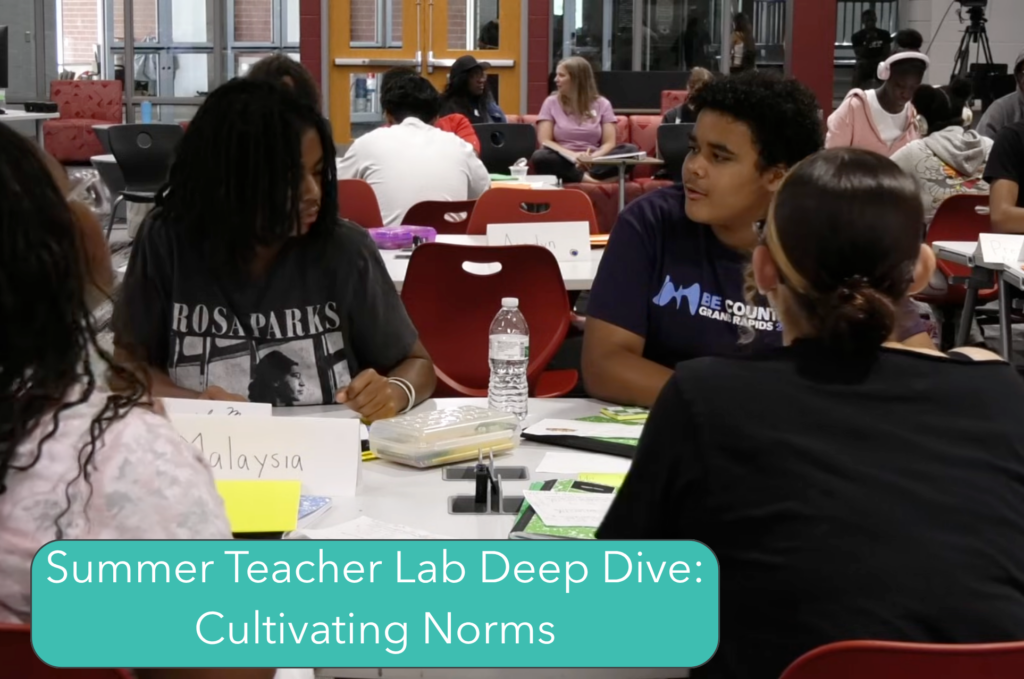
In June 2026, Math Medic Foundation’s inaugural Summer Teacher Lab brought 20 secondary math teachers and 20 high school students together for four days of learning, with teachers observing live instruction to study student thinking, engagement, and instructional decisions. In our STL Deep Dive series (here’s our first one, in case you missed it!), we’re using clips from those classroom sessions to take a closer look at the teaching practices that shaped the experience.
What happens when students stop looking to the teacher to decide whether an idea is right?
On Day 3 of Summer Teacher Lab, students worked through an activity that, at first glance, might not look particularly mathematical. There were no equations to solve, formulas to remember, or procedures to follow. Instead, students debated questions like how long it might take to cross the country on crutches, roller skates, or a bicycle.
But the activity wasn’t really about crossing the country. It was about building the kind of classroom students would need when mathematics became more challenging.
Before you watch, we invite you to pay attention to three things happening in the classroom:
- Who has the authority? Between 2:07 and 4:01, notice where students turn when they aren’t sure about an idea. Do they look to Sarah, our model teacher, or to one another?
- Whose knowledge counts? At 5:35 and 6:22, listen for the ways Sarah invites students’ own experiences into the conversation.
- What counts as a good answer? At 4:25–4:50, notice what happens when students have an answer but haven’t yet explained why they believe it.
As you watch, consider what these seemingly small interactions are teaching students about how this math classroom works.
Shifting Authority
Did you notice how comfortable the students were working with each other instead of relying on the teacher?
In a traditional math classroom, authority usually flows straight from teacher to student. Think about how often students finish a problem and immediately look up to ask, “Is this right?” They are looking for external validation before they feel comfortable moving on.
But what happens when the teacher doesn’t have an answer to give or when there isn’t one obvious “right” answer? Non-curricular tasks create opportunities for students to rely less on teacher validation and more on their own reasoning and the thinking of their peers. Instead of asking, “Is this right?” students begin asking different questions: Does this make sense? What evidence supports it? Does someone else see it differently?
That’s the shift we’re after. The teacher is still an important part of the classroom, but they don’t have to be the source of every answer. Students can learn to test ideas, challenge one another’s thinking, and decide whether an argument holds up.
By Day 3 of Summer Teacher Lab, we had already noticed a significant shift in authority from teacher to students, and this activity helped deepen that shift. Students weren’t waiting for Sarah to validate every idea; they were listening to one another, questioning one another, and deciding whether their group’s reasoning held up.
Interestingly, the one time Sarah stepped in was when a student didn’t know where New York was. And, in full transparency, she may have stepped in a bit too fast (we’ve all been there, right?). If she could do it again, she might wait a few more seconds or simply ask, “Can anyone in the group help?”
It’s a tiny instructional decision, but an important one. Every time we answer a question, redirect it to the group, or simply wait, we’re sending students a message about where knowledge and authority live in the classroom.
Cultivating Belonging – Using Quasi-Interesting, Math-Adjacent Tasks
At first blush, you may have thought that this particular non-curricular task may have missed the mark a bit. I mean, how many students really care about strange ways of crossing the country?
However, I’d like to argue that this kind of quasi-interesting task is actually very well-suited for norm-building. Suppose you chose a non-curricular task about football. Sure, the students in the room who like sports might be all in. But what about students who aren’t into sports? They may quite reasonably feel that their opinions aren’t as valuable as the sports fans in the room.
Just like that, in our attempt to cultivate belonging for all of our students, we inadvertently left some students out. This activity specifically called out golf, cars, bicycles, roller skates, and crutches. Notice how this flattens and expands who has expertise? It’s fairly likely that most students in the room have had a relevant experience to at least one part of this activity.
But wait! There’s another important reason that this task is well-suited for norm-building: it also happens to be math-adjacent. Without most students even realizing it, this task asks them to use a fair amount of number sense. They not only have to understand the differences between numbers like 18 and 77, students also have to ask themselves and each other how reasonable their answers are. Could you really use crutches to cross the country in 13.22 days? Some of these questions of reasonableness were voiced out loud while others remained implicit. Either way, students were estimating, comparing quantities, assessing reasonableness, and using number sense, all without feeling like they had been handed a traditional math problem.
Justifying Ideas with Evidence
The students showed a tremendous amount of growth in this area across the week. Even so, this is still a tricky skill for many students.
It’s easy, especially for a non-curricular task, to justify an idea by saying “Isn’t it obvious?” But that’s exactly why a task like this can be such a useful place to establish the norm.
When the mathematics itself isn’t overwhelming, students have more capacity to focus on how they communicate their thinking. They can practice saying “because,” pointing to evidence, questioning someone else’s reasoning, or changing their mind when another explanation is more convincing.
Notice how Sarah pushed students to justify their ideas from 5:50-7:10 in the video. This is such an important norm to build! Here, in this class, all ideas have value and all ideas must be justified with evidence, be it with mathematical evidence or evidence from our personal experiences.
A low-stakes task is a great place to practice this. When students aren’t consumed by complex calculations or worried about getting the “right” answer, they have more capacity to focus on how they communicate their thinking. They can practice saying “because,” pointing to evidence, questioning someone else’s reasoning, and even changing their minds when another explanation is more convincing. Then, when the mathematics becomes more challenging, the expectation has already been established: an answer isn’t the end of the conversation.
Oh, By the Way…Norm-Building Pays Off!
In case you missed it, we recently shared our Summary Report of the Summer Teacher Lab experience, which shows that students’ feelings of belonging and math identity increased significantly over the course of the program.
While it may be easy to view non-curricular norm-building activities as optional icebreakers or “fun breaks” from the content, their impact goes far beyond creating welcome classrooms. Educational research on complex instruction and groupwork in mathematics (such as the work of Jo Boaler) demonstrates that when classrooms systematically establish norms around shared authority and justification, student performance on assessments goes up significantly. This holds true especially for historically underserved students.
So, intentional norm-building does not just boost belonging and math identity. It also sets the stage for higher academic achievement down the road.
Try It in Your Classroom
Norm-building doesn’t require a week-long program or a perfectly designed activity. The next time students work in groups, pay attention to a few questions:
- Who do students look to when they’re unsure?
- Whose knowledge and experiences are useful to the group?
- When a student makes a claim, is “I just know” enough or is reasoning expected?
- And perhaps most importantly: What are students learning about what it means to be good at math?
The answers to those questions tell us a lot about the norms we’ve built, whether we intended to build them or not.

Pete Grostic, Ph.D
Executive Director
Please join Math Medic Foundation in our mission to improve math outcomes for all. You can contact us to get involved or donate here.