
Our Work > Summer Teacher Lab Deep Dive: Number Talks
Summer Teacher Lab Deep Dive: Number Talks
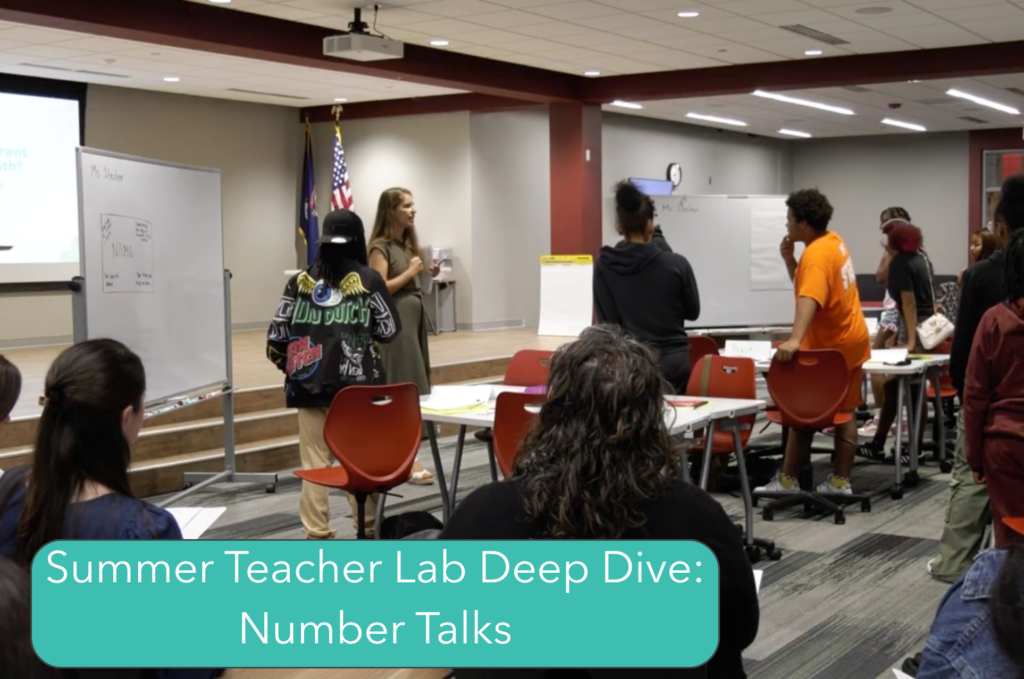
In June 2026, Math Medic Foundation hosted its inaugural Summer Teacher Lab (STL), an innovative professional learning experience focused on strengthening equitable mathematics instruction. STL brought 20 secondary mathematics teachers and 20 high school students together in the same classroom for four days of learning. Each morning, students engaged in mathematics instruction while teachers observed student thinking, engagement, and instructional decisions. Read the full STL Summary Report here. These classroom sessions were recorded, and over the next several articles, we’ll take a closer look at one aspect of the STL experience.
This article takes a closer look at the daily number talks our model teacher, Sarah Stecher, used to begin each day. As you watch the 3–4 minute clip from each day, pay attention to three things:
- Student comfort: How comfortable do students seem sharing their thinking?
- Teacher focus: What is Sarah emphasizing or looking for?
- Student strategies: How many different strategies are students able to generate, and how well are they able to explain their thinking?
Viewer notes: You’ll see the observing teachers in the foreground, background, and milling about in these video clips. In this first video clip, Sarah had met these students just 10 minutes earlier.
Day 1
- Student comfort. Do you notice the students’ slight embarrassment and awkwardness? Look familiar? For me, this is similar to every first day of school I ever experienced, both as a student and teacher. Not all of the students even stood up when asked. Many of them look as if they want this activity to be over as quickly as possible.
- Teacher focus. Notice how Sarah intentionally ignores the awkwardness? She takes every student comment seriously. She’s not trying to parse out which comments are intended to be silly or not. She has a job to do: build her classroom culture—in this math class, your comments are valued and you are capable. Full stop. Sarah is looking past the Day 1 awkwardness and expecting the tone she’s setting to pay off on Day 3 or Day 4. Keep watching below to see if she’s right!
- Student strategies. Not much to see yet, right? Still, Sarah values every strategy that is shared. She works to understand it and asks students to explain. She very intentionally devalues the correct answer (she never even reveals it!) in favor of strategic thinking and explanation.
It would be easy to abort the mission after Day 1 and tell ourselves “students don’t have enough prerequisite skills to be successful at this”, or “the students just don’t like this”, etc., etc., etc. Having been in the room myself, I can honestly say that I was not super confident that the number talk experience would improve over the next few days. Sarah makes the choice to stick with it.
Day 2
- Student comfort. It’s a bit better on Day 2, right? There are still students who look distracted or disinterested, but it’s better. The giggling has diminished, and the confidence to share has ticked up slightly. Take the small win.
- Teacher focus. Sarah’s focus is squarely on valuing student strategies. She spends the time to showcase the strategies offered, continuing to take students’ comments seriously and working to understand their thinking, just as she did on Day 1. She also works to position the students as the primary thinkers in the room. She doesn’t finish an incomplete strategy herself—she waits until another student notices: “Khari’s saying we still have to do 10 x 20.” This is an important move in creating an equitable classroom culture centered around students.
- Student strategies. Students are more willing to explain their thinking, another small win. Sarah notices, however, that the students’ strategies are all some version of the standard algorithm, so she offers “Doubling and Halving” as a way to show them that it’s okay to get creative. In this way, and only at the end, she’s giving them a bit of a nudge.
Okay, there’s noticeable progress from Day 1 to Day 2. We’re not there yet, but there’s now clear evidence for sticking with it and seeing where it goes. Let’s check out Day 3!
Viewer note: The student audio is quite soft in this next clip – you may want to turn up your volume for full effect.
Day 3
- Student comfort. The students look much more comfortable with the routine of standing and using their fingers close to their chests to indicate how many strategies they’re thinking about. More importantly, the students also look more comfortable sharing different strategies. Did you catch Sydney’s contribution? She hadn’t spoken much, if at all, to this point of the week. Gigantic growth there. Overall, it’s not perfect, but we’re seeing noticeable improvement from Day 2.
- Teacher focus. On Day 3, Sarah’s focus is consistency. Each day, she’s quickly asked for possible answers from students, but has spent the majority of the time asking for strategies and reasoning. Today is no different. Sydney, our quiet student who has not spoken up much, knows Sarah is going to ask for more strategies. So, while Sydney isn’t quite ready to be the first student to share, she’s willing to share second and she’s confident in bringing back a strategy from yesterday. Consistency, patience, trust in the process—Sarah knows these things matter in creating equitable math classrooms.
- Student strategies. With Sydney sharing the “Doubling and Halving” strategy, students are beginning to branch out from the standard algorithm. They are no longer caught off guard when Sarah asks them to explain their thinking. It’s beginning to feel like this is just what we do here.
Who’s excited to see Day 4?!
Day 4
- Student comfort. The level of student comfort is high. Many students aren’t hiding the number of strategies they’re thinking of—they’re counting out loud and already beginning to share their reasoning with a neighbor. One student is excited to share something with Sarah—not the correct answer, but that they thought of 5 strategies! In 4 days, the goal of math class has shifted from finding right answers to thinking and reasoning as much as possible. Whoa.
- Teacher focus. Sarah is in celebration mode today. She knows she and her students have worked hard to get to this point and she’s going to honor that hard work. She looks absolutely giddy with anticipation at what her students will share. To be clear, she isn’t wavering from the norms she’s set – it wouldn’t have felt as fulfilling to her students if she did – but she wants them to feel how proud she is. And her expression of pride is earned and completely genuine. Her students actually care that she’s proud of them. That’s the payoff Sarah was hoping for on Day 1.
- Student strategies. Keach starts us off by sharing a brand-new strategy—one that no one has shared all week. The consistency with which Sarah has invited new thinking has paid off in a big way here. Students are sharing new strategies confidently, not worried about mistakes because they know the purpose isn’t just about finding the correct answer. And, oh by the way, did you notice Day 4 is when students were best at finding the correct answer?! It turns out that taking the focus away from correct answers may in fact lead to more correct answers.
Lasting Implications
As nice as it is to see this kind of rapid growth during number talks, it’s even more exciting to think about how students will carry this way of thinking into their math lessons for the day. Number talks are just the appetizer—the lesson is the entrée. Sarah has made it clear that in this math class, our focus isn’t about correct answers. Our focus is on thinking and sharing our reasoning. We learn from each other, not just the teacher. This way of learning isn’t just more equitable than teacher-centered learning; it’s also more engaging and more likely to stick with students. If you haven’t yet, check out the students’ perceptions about math changed after completing the Summer Teacher Lab by reading our full report here.
The growth we just witnessed isn’t because we chose the most academically advanced students for STL (we didn’t) or because we hand-picked the most exciting math topics (we didn’t). But, the growth we just witnessed also didn’t happen by accident. Sarah started the week by taking students seriously and believing they were capable. She continued by valuing all student thinking and staying consistent with her routines and priorities, and she finished the week by celebrating students’ growth. Simple as it may seem, these were intentional moves that shaped Sarah’s every action. Sometimes, the most powerful changes begin with simply believing students are capable of more.

Pete Grostic, Ph.D
Executive Director
Please join Math Medic Foundation in our mission to improve math outcomes for all. You can contact us to get involved or donate here.